


Hela – “A Reign To Conquer” – Atanathos
There are bands within doom metal that seem to move in a straight line, repeating established formulas until their identity becomes predictable. And then there are those that evolve with patience, allowing their music to grow naturally without losing its essence. When I listen to «A Reign To Conquer», the new album by Hela, I have the distinct feeling of being before one of those projects that has chosen the long road—that of slow but honest artistic maturation.
Hailing from Elche, in the Valencian Community, Hela emerged in 2012, taking their name from the Norse goddess of the underworld. That choice was not merely aesthetic. From the beginning, the group showed a special affinity for somber atmospheres, emotional introspection, and narratives connecting the human with the mythical. Their debut «Broken Cross» quickly garnered attention within the European doom circuit, to the point that the respected Finnish label Svart Records decided to release it on vinyl—a clear sign that the band had caught the right ears.
With their subsequent works, «Death May Die» and «Vegvísir», Hela consolidated a very particular sonic identity within melodic doom. This was not a band obsessed with extreme heaviness or typical doom/death aggression. Their focus was always closer to atmospheric emotion, vast soundscapes, and a melancholic sensibility that often recalled the 90s atmospheric metal tradition more than the heavier currents of the genre.
However, the passage of time brought a period of silence. The global pandemic, coupled with the inevitable personal changes that life imposes, caused a pause in the group’s activity. For several years, Hela virtually disappeared from the radar. For many followers, the project seemed to have entered one of those indefinite hiatuses that so often turn into silent goodbyes.
That is why the arrival of «A Reign To Conquer» feels somewhat like an unexpected reappearance. But what is most interesting is that the band doesn’t simply return to pick up where they left off. This album introduces a major change: the addition of new vocalist Raquel Navarro. From the first moment, it is evident that her presence is no minor detail, but rather one of the elements redefining the album’s personality.
Raquel’s voice possesses an ethereal quality that fits perfectly with the emotional dimension of Hela’s sound. It is not a theatrical or overly ornamented performance; instead, it conveys a blend of fragility and serenity that acts as a guiding thread throughout the album. At many points, her timbre recalls the tradition of female voices that marked the evolution of atmospheric doom in the nineties.
The record opens with “Vessel To Nowhere”, a piece that immediately sets the tone. The opening chords are dark and heavy, almost threatening, as if the music were building an inhospitable landscape before allowing the listener to enter. Gradually, the melodies break through, and Raquel’s voice introduces a deeply human element into that cold atmosphere.
One of the aspects that strikes me most about this song is Julián Velasco’s guitar work. His melodic lines don’t seek technical spotlighting; instead, they function as emotional currents that slowly heighten the track’s intensity. The result is a powerful and enveloping opening.
The second track, “The Infinite Tower”, introduces an interesting shift in tone. Here, the music takes on a more ethereal, almost dreamlike character. The guitars move between delicate passages and moments of greater intensity, creating a sense of continuous ascent that perfectly matches the image of the infinite tower suggested by the title.
At this point, I begin to perceive one of the most remarkable qualities of «A Reign To Conquer»: its ability to create complex emotional landscapes without relying exclusively on sonic heaviness. The album breathes, expands, and contracts, alternating moments of introspection with carefully calculated melodic explosions.
“Crystal Bridge” represents one of the most emotive moments on the album. The song is built on a deep melancholy that gradually transforms into a climax of enormous intensity. It is one of those tracks that seems to speak directly to the listener without the need for grand lyrical artifice. Here, Raquel’s voice reaches one of its highest points, conveying a mix of nostalgia and hope that fits the instrumental crescendo perfectly.
“Emerald Mirror” introduces a slightly different approach. The track possesses a sense of constant movement, as if the listener were traversing a changing landscape. The guitars create a sonic texture rich in nuances, while the rhythm section maintains a steady pulse that prevents the atmosphere from becoming too airy.
One of the most interesting aspects of the album is how each song seems to represent a stage within a broader emotional journey. It isn’t a conceptual album in the strictest sense, but it does convey the feeling of moving through different states of mind.
“Architect Of Disorder” provides one of the most introspective moments. The song has an almost elegiac air, with a rhythm reminiscent of a slow waltz floating between memories and absences. It is a track that demonstrates the band’s ability to build dense atmospheres without resorting to aggression.
Finally, we reach “Nomad”, the album closer. It is here where everything seems to find its place. The song conveys a sense of perpetual motion, of an endless search. The «nomad» of the title seems to represent someone condemned to walk the world’s paths accompanied only by the ghosts of what once was. Musically, the track functions as a synthesis of everything presented thus far.
In terms of production, the album features a very polished sound. It was recorded at Red Records in Alicante with José Francisco Rojo, mixed by Julián Velasco himself, and subsequently mastered by the legendary Dan Swanö, a key figure in European metal production over the last few decades. Swanö’s involvement does not go unnoticed; the record has a notable sonic clarity where every instrument finds its space without losing the characteristic density of melodic doom.
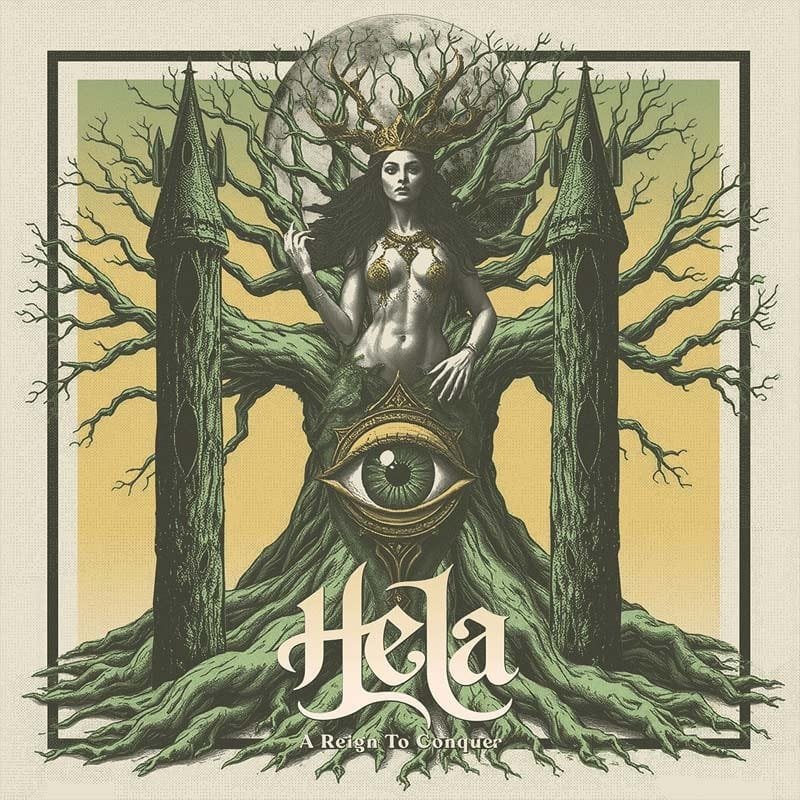
The cover art, created by Deadsign, reinforces the album’s introspective aesthetic with evocative imagery that perfectly matches the emotional tone of the music.
If I had to summarize my experience with «A Reign To Conquer», I would say it is a deeply honest record. Its goal seems much simpler and, at the same time, more difficult: to create sincere music that connects emotionally with the listener. In a scene where many bands seek to stand out through speed, aggression, or technical experimentation, Hela opts for something different. Their songs are built from emotion, from the silence between chords, and from the patience required to let melodies breathe.
Some listeners might find the album too contemplative or even excessively melancholic. But that is precisely where its strength lies. After several years of silence, Hela returns with a work that proves the band is not only still alive but has found new ways to express its musical identity.
Score: 9 / 10
«A Reign To Conquer» is not an album that seeks to impress on the first listen. It is a work that grows slowly, revealing new nuances each time you return to it. And in the current context of metal, that is an increasingly rare virtue.
También te interesaría leer:
Acerca del autor