


Graves for Gods – “Last Light Fades” – Atanathos
There are albums born to entertain, others to impress technically, and some—the most interesting ones—to provoke deep reflection in the listener. When I first encountered «Last Light Fades», the second album by the Australian band Graves For Gods, I had the immediate sensation of being before a work that attempts to place itself in this third category. This is not merely an exercise in orthodox doom/death metal; it is a conceptual album that utilizes the emotional weight and sonic density of the genre to build a historical and philosophical narrative about power, faith, and human decay.
Formed in 2020 in Adelaide, Graves For Gods initially appeared on the scene with their debut «The Oldest Gods» (2022), a work that already hinted at their fascination with the most solemn and spiritual roots of classic doom/death. That first offering clearly established the group’s DNA: slow, monumental riffs, cavernous vocals evoking ancient rituals, and an atmosphere steeped in historical melancholy.
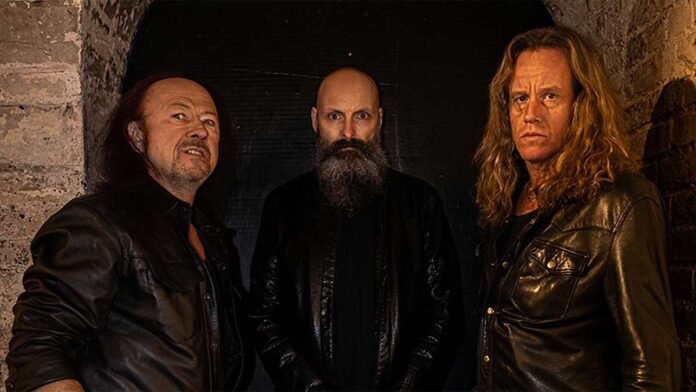
With «Last Light Fades», the trio composed of Jak Shadows, Matt Spencer, and Ryan Quarrington does not settle for repeating the formula. The record expands the band’s ambitions both sonically and conceptually. From the very first moment, I perceive that the intention is to create something more than a simple collection of songs: it is a journey through the cycles of power and decline that have marked human history.
The album’s central concept revolves around the rise and fall of empires, particularly the Roman Empire. However, the band does not limit itself to a literal historical recreation. What they propose is a broader metaphor for how societies are built upon belief systems—religious, political, or ideological—that eventually end up corrupted. This idea of idolatry and ideological manipulation runs through the entire album as a common thread. In this sense, «Last Light Fades» fits into an extreme metal conceptual tradition that uses history as a mirror for contemporary conflicts.
Musically, the influence of the so-called “Peaceville Trinity” is evident from the first bar. The spirit of My Dying Bride, Paradise Lost, and Anathema constantly hovers over the compositions, not as a superficial copy but as a stylistic heritage that the band has managed to reinterpret. Nevertheless, Graves For Gods does not limit itself to replicating the 90s doom/death aesthetic. They also incorporate modern production elements and a more dynamic compositional structure that prevents the songs from becoming excessively linear.
The album opens with “Perpetua Fell”, a piece that functions as a portal into the record’s conceptual universe. From the first chords, I feel the band seeking to create a sense of almost liturgical solemnity. Matt Spencer’s guitars unfold with a grave, resonant tone, while the drums mark a heavy rhythm reminiscent of a funeral procession. Jak Shadows’ vocals deserve special mention; his guttural register is not just an aggressive resource but functions as a dark narrator guiding the listener through the ruins of forgotten civilizations. His performance has an almost theatrical quality that fits the album’s epic dimension perfectly.
The second track, “The Dark Age”, delves even deeper into the historical narrative. The title refers to the periods of transition and decay that follow the fall of great empires. Musically, the track alternates between extremely slow doom sections and moments where the intensity slightly increases, generating a contrast that maintains tension. This is where I begin to notice one of the album’s greatest successes: the way the band handles sonic space. Each riff has time to breathe; every drum hit seems calculated to maximize emotional impact.
“Unholy Ghost” represents one of the most unsettling moments of the record. The song explores the darker side of organized spirituality, suggesting that religious institutions can become instruments of control and manipulation. The atmosphere is oppressive, almost claustrophobic, reinforced by guitar work that combines heavy chords with somber melodies. At this point in the album, the conceptual narrative begins to take on an almost cinematic character. Each song functions as a chapter within a broader story about the corruption of power.
“Covered in Blood” introduces an interesting shift in the record’s dynamics. Although the tempo remains relatively slow, the emotional intensity increases considerably. The guitars take on a more aggressive tone, and the drums show a slightly more direct approach. The song evokes images of religious wars, persecutions, and sacrifices performed in the name of gods and emperors. It is one of the moments where the album reaches its highest dramatic peak.
Finally, we arrive at the title track: “Last Light Fades”. As the album closer, this piece has the difficult task of synthesizing all the musical and conceptual ideas developed previously. The result is a long, deeply atmospheric composition that conveys a sense of historical inevitability. The “last light” mentioned in the title can be interpreted as the disappearance of an empire, a faith, or even an entire civilization. Musically, the track combines some of the album’s most emotive riffs with passages where the guitars adopt an almost elegiac tone. The general feeling is that of witnessing the end of an era.
One of the most interesting aspects of «Last Light Fades» is its production. The album was mixed in Adelaide by Matt Spencer and mastered by Dav Byrne at Iridium Audio. The result is an organic, heavy sound that maintains a very effective balance between clarity and density. Ryan Quarrington’s drums sound powerful without being excessively polished, which helps maintain the record’s dark character. The guitars, for their part, have a deep tone that perfectly fits the doom aesthetic.
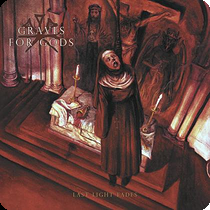
The visual work also does not go unnoticed. The cover created by Greallach Art reinforces the album’s themes with an aesthetic evoking ruins, ancient rituals, and forgotten monuments. This kind of aesthetic coherence is vital in a conceptual album like this. Everything—from the music to the graphic art—contributes to creating an immersive experience.
If I had to point out any weakness, I would say the record could benefit from greater structural variety at certain moments. Being an album deeply rooted in traditional doom/death, some passages may feel predictable to listeners very familiar with the genre. However, that apparent limitation is also part of the album’s charm. Graves For Gods is not trying to reinvent doom/death; their goal is to explore its emotional and narrative potential. And in that sense, the album more than fulfills its purpose.
In an era where many bands seek to stand out through speed or technical complexity, «Last Light Fades» bets on something different: the construction of dense, reflective atmospheres that invite the listener to contemplate human history from a broader perspective. It is an album that does not intend to be heard superficially. It requires patience, attention, and a certain predisposition to let oneself be enveloped by its slow rhythm and symbolic weight.
After several listens, my impression is that Graves For Gods has managed to consolidate its identity with this second work. If «The Oldest Gods» was the statement of intent, «Last Light Fades» is the confirmation that the band has a clear vision of what it wants to express. It is not a record that seeks to please everyone. Its solemn approach, deliberately heavy tempo, and historical themes may feel too dense for some listeners. But for those who enjoy doom/death in its most introspective and conceptual form, this album represents a solid and coherent proposal.
Score: 8 / 10
Ultimately, «Last Light Fades» is a work that honors the tradition of classic doom/death while proving that the genre can still serve as a vehicle for profound reflections on history, faith, and human nature.
También te interesaría leer:
Stalwart consolida su regreso con el lyric video de "Sacrifice" y el lanzamiento de "Tempvs Edax Rer...
SUNN O))) editará su álbum homónimo: "Glory Black" es el primer single del grupo de Drone Doom Metal
Lamb of God anuncian "Into Oblivion", su duodécimo álbum de estudio - Atanathos
DUSK regresan con “Bunker”, su nuevo disco de metal oscuro y opresivo
Acerca del autor